

For more than 100 years, personal protective equipment (PPE) has had one signature piece: the hard hat. It is iconic — like cowboy boots in Texas. Hard hats became the industry standard in the early 1900s, and they have done their job well by keeping workers safe from things falling straight down on their heads. But let’s be honest, construction has changed, and so has our understanding of safety. It is time for our head protection to meet today’s ever-changing needs.
In today’s construction environment, safety helmets are taking over jobsites everywhere. Milender White, along with every company represented on ABC Rocky Mountain’s board of directors, has either already made the switch to helmets or is well on their way. This is not a fad, like parachute pants or mullets; helmets are the future.
Why Helmets?
Hard hats are good at one thing: the safe deflection of sudden falling objects. A few things that hard hats are not so great at protecting against are the other real dangers of construction: lateral hits, slips, trips and falls.
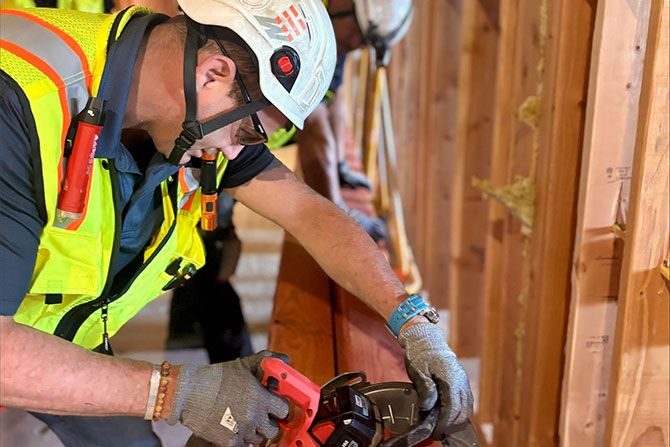
That is where helmets shine. Take the Kask Zenith X, the model Milender White uses. These helmets borrow design smarts from rock climbing and cycling, where protecting heads from falls and sideways impacts has been the standard for decades. They offer all-around total skull coverage, plus a chin strap that keeps the helmet where it belongs, safely on your head.
The Pushback (And Why It Is Fading)
When helmets first appeared on construction sites, not everyone was lining up to trade in their trusty hard hats. We have heard it all — “They look silly,” “They feel different,” and, of course, “That’s not what a real builder wears.” The pushback was loud, but as time has shown, helmets are not about fashion but protection that keeps pace with the hazards of today’s job sites.
Objections are fading as helmets prove themselves in the field. Modern designs come with better ventilation, sweat-wicking liners and even attachable accessories like visors and brims. More importantly, they have started to shift the job site culture. Workers no longer see them as a hassle. They see them as a sign that their company genuinely cares about their safety.
A Cultural Shift
This is not a forced change, but rather a paradigm and mindset shift. Helmets demonstrate how companies are thinking beyond what meets minimum safety requirements to prioritize their people, their most valuable asset. In addition, it sends a clear message: “We value you as a person and want you to go home to your loved ones safely.” This kind of message builds trust, boosts morale and sets an example for new workers entering the industry.
Safety helmets are helping to reshape the image of construction. Rather than clinging to tradition, the industry is proving it is forward-looking, innovative and, dare we say, “stylish in its own way.”
Momentum Is Building
The safety helmet movement is not just happening in Colorado. Across the country, contractors are piloting helmet programs, picking models and rolling out new policies. Safety organizations like OSHA and NIOSH are highlighting the benefits, too. Helmets are not just “nice to have” — they are becoming the standard.
What’s Next
As safety helmets become the new norm, the next step is education and innovation. Workers need to know how to wear them correctly (hint: chin strap actually buckled), and why they matter.
Wrapping It Up
The hard hat will always hold a place in construction history; however, helmets are the future. By adopting them, companies prove they value safety, innovation and most importantly, their people.
So, the real question isn’t whether construction will fully transition to helmets — it’s how soon. Based on momentum, the answer is: faster than you can say “chin strap.”