



Workforce development is something I’m deeply passionate about. I came up through the trades and I still believe today that construction is one of the most rewarding and opportunity-rich industries out there.
To explore how we can attract, grow and retain the next generation of talent, I sat down with four industry professionals who represent different paths, roles and stages of their careers. These industry enthusiasts identified what’s working and what still needs to evolve in our approach to workforce development.
Meet the Contributors
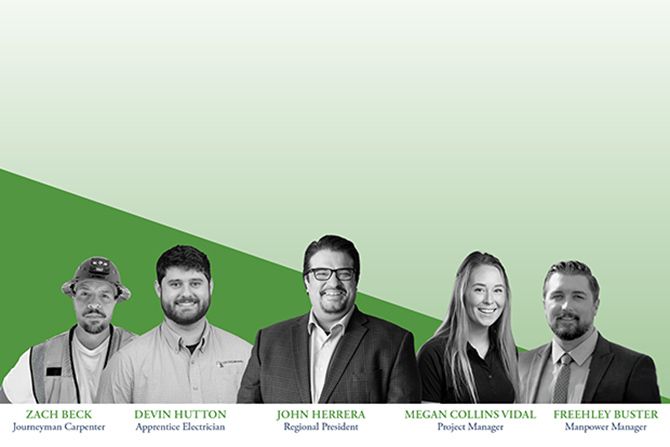
Devon Hutton grew up on a farm in northern Minnesota, where hands-on work was a way of life. He entered the electrical trade as an apprentice in his hometown before making the move to Colorado. Today, he’s building his career as an apprentice electrician at Encore Electric.
Freehley Buster once bartended a private Super Bowl party for Will Ferrell. An experience that prepared him for the organized chaos of the jobsite. He began his construction career 12 years ago as an apprentice electrician and now serves as manpower manager at Encore Electric, where he coordinates staffing across multiple projects.
Megan Collins Vidal launched her construction career as a college intern with Adolfson & Peterson Construction (AP). A graduate of Iowa State University’s construction engineering program, six years later, she leads teams as a project manager. Off the clock, Megan enjoys translating her project skills to the kitchen, where she experiments with bold flavor combinations and unexpected ingredient pairings.
Zach Beck began his construction career in 2007 as a welder, later finding his calling in carpentry. Now a journeyman carpenter with AP, Zach has been with the company for over four years and recently graduated from the CITC carpenter apprentice program (May 2025). A creative at heart, he enjoys drawing and has always had one of these hands-on projects in his work.
Contributor Q&A
What role does upward mobility play in career satisfaction? How can construction companies better support individual growth?
Devin Hutton: I think having a mentor in construction plays a critical role in employee growth. Having my foreman or a similar person to rely on and teach has driven me to become a better electrician.
Freehley Buster: Career satisfaction varies from person to person. For some, upward mobility is critical; for others, it’s more about personal development or work-life balance. The key is understanding each individual’s goals and supporting them accordingly — whether that’s through new experiences or formal career advancement. Companies should provide transparency about real-world career paths, recognizing that while few will reach executive levels, everyone deserves a chance to grow.
Megan Collins Vidal: The role of upward mobility depends on the individual, where they find motivation and how it aligns with personal goals they have set for themselves. Organizations can better support individual growth by understanding what motivates their employees and giving them opportunities that are in alignment and challenge the individual. Construction companies should identify opportunities internal to their organization and externally within the industry to encourage well-rounded individual growth.
Zach Beck: I believe that upward mobility plays a massive role in career satisfaction. With AP, I started as a laborer, became a carpenter’s apprentice, and am now a journeyman carpenter after completing trade school. With each move, I’ve received pay increases, more responsibility, increased trust and ultimately have become more confident overall. The satisfaction I have with my role in AP is honestly immeasurable. Working in different industries, I was able to recognize that I wasn’t always afforded the opportunities that I’ve received here, and looking back, I can remember how I felt that I was stagnating. I worked really hard to get to where I’m at now and I appreciate that AP not only saw the potential in me but also offered a path to something greater.
John Herrera: Upward mobility is not just a factor; it’s a cornerstone of career satisfaction. When employees can see a clear path for advancement, they’re not just more motivated, engaged and loyal to their company, they feel valued and important.
What do we need to address, beyond perception, to make construction a more compelling career choice in today’s job market?
Freehley Buster: People don’t know what they don’t know. We need to keep showing up and educating the broader public — not just students, but adults looking for career changes. I personally transitioned into construction from another industry. There’s huge potential to attract mid-career professionals. As an industry, we need to better communicate real-life career paths and success stories in construction.
Megan Collins Vidal: The industry needs to understand what employees are looking for and how to make it fit within the industry. Most often, you hear that roles within the industry lack flexibility, are too stressful, physically taxing and offer limited career advancement. If you are unable to have flexibility within the role, can you offer other supplemental benefits that lessen the burden, like a more generous PTO program or childcare assistance?
Zach Beck: I think the things that we have to address to make construction a more compelling career choice are fairly simple. Some of these things include giving clear pathways to show that you can start anywhere in the industry and still can progress and promote, building more inclusive environments and continuing to attend high school job fairs to promote safe workplaces. I believe we should lean into the fact that the things we do are completely tangible and there are so many people who just want to be able to physically see what they’ve accomplished.
How do we shift the perception that construction is “old school” or lacking innovation? What can companies do to show that growth and career advancement are truly possible?
Devin Hutton: My favorite example of how we are moving away from old school is our drawings. I’ll never forget handing a brand-new first-year apprentice an iPad to show him some rough-in locations for outlets. He thought we were going to flip through 100 pages of paper prints to find the one room we were standing in. The shock on his face is something I will always remember.
Freehley Buster: I believe this perception has already started to shift over the last 5-10 years. Still, change takes time. We can’t control how other industries see us, but we can control how we present ourselves. We need to spotlight innovation — the new technology, tools and processes that are transforming how we build. Showcasing these advancements can help demonstrate that construction is forward-thinking and full of opportunity for growth and advancement.
Zach Beck: I actually don’t believe we should FULLY shift away from the perception that construction is “old school.” It’s not inherently “old school” as much as it’s timeless. Things have always and will always need to be built. The things that I believe we need to focus on are showing the advances in our industry. We should not only show the things that we’ve always done but we should show the tools and methods that we use now, like drones, lasers and ground penetrating radar. I believe that if we show our desire to encourage advancement and offer training, it will naturally show career advancement.
John Herrera: To combat the perception that construction is “old school,” companies need to actively highlight their use of modern technology. Sharing videos and case studies of innovative projects that utilize drones, robotics and virtual reality can be incredibly effective. But more than that, showcasing success stories of employees who started in entry-level positions and advanced to leadership roles can make the audience feel proud and inspired. This provides tangible proof of growth and demonstrates that a long-term, rewarding career is within reach.
How can we include more people in construction and make the industry a place where they want to stay and grow?
Freehley Buster: It starts with focusing on the individual. We need to be transparent about what it really means to work in construction and break down the perceived barriers to entry. There’s a place for everyone in this industry — whether it’s in the field, in management or in support roles. We need to actively educate people on what it does and doesn’t take to succeed here. Once again, we are our own best recruiters. It’s on us to help others understand and see themselves in this work.
Megan Collins Vidal: We can include more people in construction by continuing to support growth and opportunities within the market and our organizations. This means connecting with clients who understand the industry and the need for experience and growth. Engaging experienced contractors working with trade partners and smaller general contractors to get their footing, gain experience and grow together. And finally, fostering community within the industry can be difficult when so much of it is based on competition, but relationships and being a resource for others can help bridge the gap.
Zach Beck: When it comes to including more people in the construction industry and making them want to stay, I think we need to make people feel like they truly belong — make people feel like they are heard and show people that when mistakes are made, there are learning opportunities instead of acting like it’s the end of the world. My managers have asked what my goals are and when I’ve told them, we have created those paths as well as goals I need to accomplish in order to get me into an advantageous position. Those personalized paths have made me feel like I belong and that I’m heard.
What keeps you motivated to stay in the construction industry? How can we better communicate those rewards to people outside the industry?
Devin Hutton: Construction is an industry that is always growing. I’ve always liked the fact that there always seems to be new things to learn. New ideas on how to approach tasks or new material on how to do a task you’ve done for years. It’s a career where, day to day, you could be doing something completely different.
Freehley Buster: I went to a four-year state college, earned a management degree and worked in hospitality before moving into construction. That outside experience helped me appreciate what this industry offers: endless opportunities, the ability to control your own path and real, tangible rewards for hard work. If we want to attract others, we need to highlight those elements — the autonomy, the impact and the clear connection between effort and reward.
Megan Collins Vidal: I am motivated by all the facets that it takes to bring the pieces together and the role I play in that. I think that we can better communicate the rewards by continuing to prioritize recruiting and advertising career opportunities to younger individuals. The use of testimonials and shared experience goes a long way.
Zach Beck: It’s actually really easy for me to feel motivated! I have an overwhelming sense of pride whenever I finish something. As long as I can physically see what I’ve accomplished at the end of the day, I’m happy. At the end of the job, I can drive by that building and show my family and friends. They don’t really understand it, but they weren’t the ones who worked on these sites. Really, I think the best way to communicate those things to people outside of the industry is mainly on a personal level. I often express that in our industry, we actually leave something behind. Buildings like schools, hotels and hospitals are used by people every single day. It’s a legacy.
How does leadership today contrast with the past?
Devin Hutton: I think the major difference between today and the past is how we are training our future leaders. I think we are being shown in better detail how to work and operate in the field. I think our leadership asks the question: “How can I help you?” more than “How can you help me?”
Megan Collins Vidal: I believe that leadership today is more focused on the human element of the workforce and the need to continue to attract and retain talent. As companies have expanded and grown across regions, it is more important than ever that the brand they worked to build is maintained through expansion. In order to do this, they need to invest in their people and build strong teams. This focus on their people and the future also supports career advancement and opportunities for their employees.
Zach Beck: I believe that leadership today is completely different from how it was in the past. The company I work for often reinforces how important a work-life balance is and that even though we have a schedule to adhere to, we can’t get those things done if we are checked out mentally. Oftentimes, you hear that back in the day, your value was measured in how many hours you were on site every single day. Somehow, you were no longer a human, but a number. Now, leadership actually takes the time to ask you about your life outside of work and how your family is. Speaking with my peers, it’s impossible to express how much it means to them to actually be recognized.
John Herrera: Leadership today is far more collaborative and empathetic than it was in the past. The traditional, top-down approach of the past has been replaced by a more inclusive style that values team input and employee well-being. Today’s leaders focus on mentorship and professional development, empowering their teams to take ownership of their work. They’re also more adaptable, embracing new technologies and strategies to stay competitive, whereas leaders of the past often relied on established, traditional methods.
Closing Thoughts
Bringing this group together was a powerful reminder: The future of construction isn’t just about filling open roles; it’s about building careers, company cultures and communities where people can grow and thrive.
These conversations shine a light on both the challenges we face and the opportunities we have to lead real, lasting change. From career pathing to culture shifts, there’s no one-size-fits-all solution. There is, however, momentum. And we all have a role to play in keeping it going.
Thanks to my co-contributors for their time, honesty and insight. Let’s keep the conversation going.
John Herrera is the Mountain States Regional President of Adolfson & Peterson Construction. He can be reached at jherrera@a-p.com.